By reclaiming the vita activa from its traditional subordination to contemplation, Arendt develops a critique that restores autonomy to the political realm
Hannah Arendt (1906–1975) was an influential German philosopher and historian. Her work occupies a central place in political theory because it refuses to treat politics as a simple question of natural law or philosophy of the mind. Across her writings on totalitarianism and political action, Arendt insists on the public, shared character of political life.
In this blog post, I will analyze the first chapter of The Human Condition (which bears the book’s eponymous title). Unlike my analysis of the Prologue (which can be found here), I will not proceed with a sentence-by-sentence examination. Instead, I am going to focus on a set of key passages that structure Arendt’s account of the vita activa and its implications for political thought.
The chapter unfolds around three conceptual sections, each of which reveals the stakes of Arendt’s reorientation of political thought. Rather than offering an exhaustive commentary, this post will analyze the first chapter of The Human Condition to clarify the stakes of Arendt’s reorientation of political thought.
**Citation Note: Full citation provided at the end of this post

I. Vita Activa and the Human Condition
Arendt opens the chapter by introducing the concept of the vita activa. She writes:
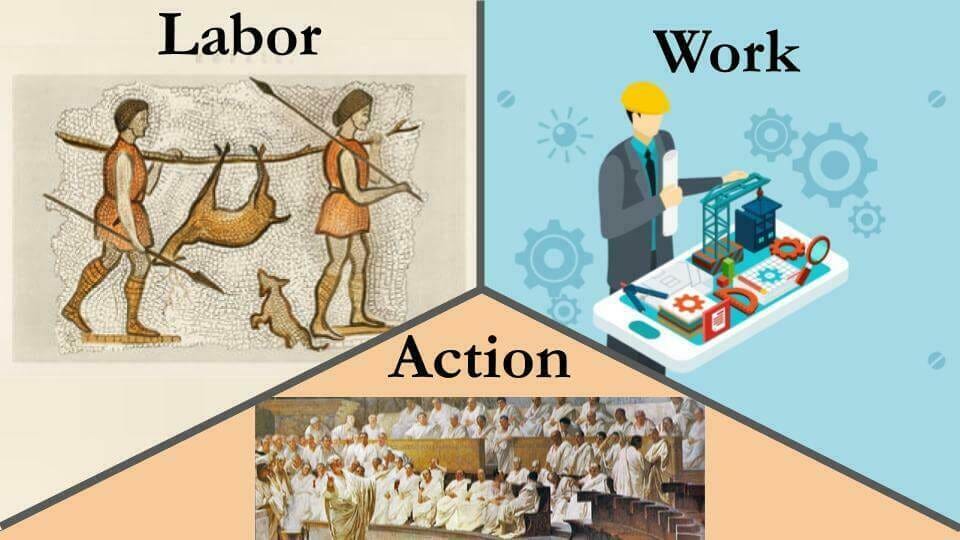
With the term vita activa, I propose to designate three fundamental human activities: labor, work, and action.
They are fundamental because each corresponds to one of the basic conditions under which life on earth has been given to [hu]man.
Arendt’s distinction between labor, work, and action is not merely classificatory. Each names a different condition of human existence, and understanding these conditions requires careful attention to how Arendt defines them. She begins by defining labor:
Labor is the activity which corresponds to the biological process of the human body, whose spontaneous growth, metabolism, and eventual decay are bound to the vital necessities produced and fed into the life process by labor.
Labor is bound to necessity. It sustains life through repetitive activity aimed at survival rather than permanence. While labor is indispensable, it does not contribute to the creation of a lasting world. For this reason, Arendt understands labor as pre-political: it secures biological life, but it cannot sustain political life because it remains oriented toward survival. For example, sexual reproduction, producing food, etc. are necessary for the continuation of life, but do not generate the institutions through which politics emerges.
Arendt proceeds to define work:
Work is the activity which corresponds to the unnaturalness of human existence, which is not imbedded in, and whose mortality is not compensated by, the species’ ever-recurring life cycle.
Work is understood as the “unnaturalness of human existence” insofar as it refers to the artificial world of objects humans create. While labor is integral to sustaining life, work produces objects that outlive individual lives and introduce a measure of permanence into a mortal world. For example, a human might exert energy to pick an apple from a tree in order to eat (labor), but they might also build a ladder to reach the apples (work) — an object that endures beyond any single act of use. In this sense, work constructs the material conditions under which political life can appear. Like labor, however, work does not itself constitute politics; it remains oriented toward production.
And finally, Arendt defines action:
Action, the only activity that goes on directly between [humans] without the intermediary of things or matter, corresponds to the human condition of plurality, to the fact that [humans], not Man, live on the earth and inhabit the world … this plurality is specifically the condition — not only the conditio sine qua non, but the conditio per quam — of all political life.
Action, for Arendt, consists of activity that occurs directly between human beings without the mediation of objects or material processes. Unlike labor and work, action is not oriented toward survival or the production of things. Instead, it unfolds within a space of plurality, in which distinct individuals appear to one another through speech. Humans relate differently to one another when they are merely sustaining life than when they inhabit a shared public world. Politics becomes possible only within this condition of plurality. (This emphasis on action as a shared, public activity is reminiscent of Aristotle, a connection Arendt develops more explicitly in the following section.)
Arendt’s conceptualization of the vita activa culminates in a broader clarification of what she means by the human condition. She writes:
… The human condition is not the same as human nature, and the sum total of human activities and capabilities which correspond to the human condition does not constitute anything like human nature.
Her distinction between the human condition and human nature reinforces her refusal to ground politics in a Platonic essence, and instead prepares the ground for her subsequent analysis of plurality.
II. The Term Vita Activa
Arendt continues:
And this tradition … grew out of a specific historical constellation: the trial of Socrates and the conflict between the philosopher and the polis.
She begins by tracing a brief history of political philosophy in order to explain why politics has been traditionally understood the way it has. Arendt locates the origins of this tradition in the trial of Socrates, who was condemned for allegedly corrupting the youth through philosophical inquiry. For Arendt, this moment crystallizes a fundamental tension between philosophy and politics: the philosopher seeks truth, while the life of the polis is structured by norms and opinions grounded not in certainty but in plurality. From the perspective of figures such as Socrates and Plato, political life appeared unstable and in need of guidance from a higher form of knowledge. It is here that Arendt identifies the beginning of a tradition in which contemplation is elevated over action — a hierarchy she will soon critique.
Arendt elaborates:
Neither labor nor work was considered to possess sufficient dignity to constitute a bios at all … since they served and produced what was necessary and useful, they could not be free…
In the classical tradition Arendt reexamines, neither labor nor work was constituted as fully human in the sense of a bios, because both were concerned with necessity and utility rather than freedom. Labor remained tied to survival, while work was oriented toward the production of useful objects. As a result, political freedom came to be understood as distance from necessity rather than engagement with the conditions of life. The political was thus defined negatively, as what stands apart from labor and work, a conception that further enabled the elevation of contemplation as the highest form of human activity.
So … Where does action fit in? She explains:
… action was now also reckoned among the necessities of earthly life, so that contemplation … was left as the only truly free way of life.
With the elevation of contemplation, action came to be classified as a form of necessity rather than freedom. In this reclassification, action lost its distinct political character and was conflated with the logic of labor and work. Politics could no longer be understood as a space of plurality, but instead appeared unstable and subordinate to philosophical inquiry. Contemplation was elevated as the only truly free way of life, while action was reduced to something merely practical. For Arendt, this transformation obscures the specifically political dimensions of human reality.
This view, however, did not end with the ancient Greeks, as Arendt notes:
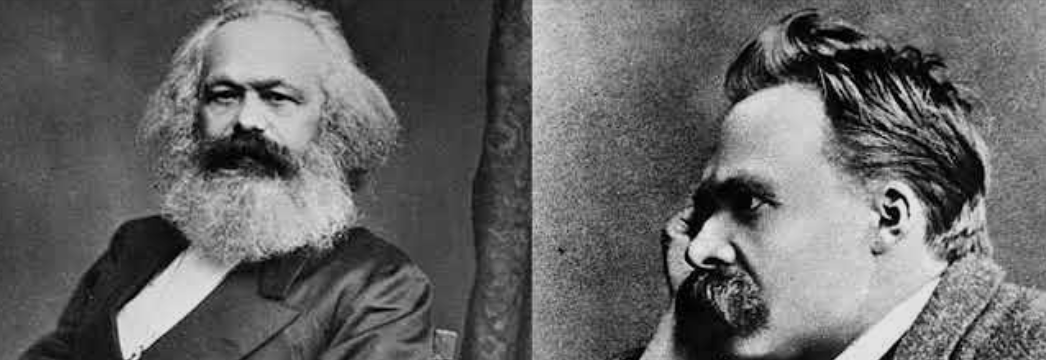
My contention is simply that the enormous weight of contemplation in the traditional hierarchy has blurred the distinctions and articulations within the vita activa itself and that, appearances notwithstanding, this condition has not been changed essentially by the modern break with the tradition and the eventual reversal of its hierarchical order in Marx and Nietzsche.
Here, Arendt articulates her overarching criticism: the elevation of contemplation over action has had lasting and negative effects on political thought. By treating contemplation as the highest human good, the tradition blurred the distinctions within the vita activa itself. Although some modern thinkers — most notably Karl Marx and Friedrich Nietzsche — appear to break with this hierarchy, Arendt argues that they ultimately simply reverse its order (action > contemplation). Arendt claims that these reversals leave the conceptual framework intact.
She concludes Section II by stating:
This assumption is not a matter of course, and my use of the term vita activa presupposes that the concern underlying all its activities is not the same as and is neither superior nor inferior to the central concern of the vita contemplativa.
Arendt clarifies that her use of the term vita activa does not simply reverse the traditional hierarchy that privileged contemplation over action. Instead, she rejects the assumption that all human activity must be ordered around a single, dominant concern. The activities that comprise the vita activa are governed by concerns fundamentally different from those of the vita contemplativa. This distinction allows Arendt to insist on the autonomy of the political realm, whose standards cannot be derived from or subordinated to metaphysical contemplation.
III. Eternity versus Immortality
Finally, in Section III, Arendt continues to describe the importance of eternity and immortality in her framework. She states:
The various modes of active engagement in the things of this world, on one side, and pure thought culminating in contemplation, on the other, might correspond to two altogether different central human concerns…
Arendt highlights two modes of human life that correspond to different central concerns. Active engagement in the world involves appearing before others and leaving traces (such as written texts) within a shared, worldly space. By contrast, pure thought culminating in contemplation is oriented toward withdrawal and permanence beyond worldly issues. This distinction is important as Arendt understands active life as inseparable from plurality and political interaction, whereas contemplation seeks distance from both. Thus, political life cannot be understood according to the standards of contemplation.
Furthermore:
The shortest, albeit somewhat superficial, way to indicate these two different and to an extent even conflicting principles is to recall the distinction between immortality and eternity.
With the distinction between active life and contemplation in place, Arendt introduces the most consequential difference between the two by contrasting immortality and eternity. Immortality refers to endurance within the world: the lasting remembrance that outlive an individual life (i.e., a philosopher leaving behind a published book). Early political life was oriented toward this form of immortality, insofar as action in the public realm aimed at leaving a trace within a shared world. Eternity, by contrast, names an existence outside of time altogether — one detached from plurality, and political interaction. Arendt argues that with the rise of philosophy, this concern with eternity came to be elevated over immortality. As a result, political life was no longer understood as a space of action but was increasingly conceptualized from the standpoint of contemplation.
She writes:
The experience of the eternal … can occur only outside the realm of human affairs and outside the plurality of [humans].
Arendt makes clear that the experience of eternity cannot occur within a shared space, because it requires withdrawal from human affairs and plurality. Contemplation, in this sense, is anti-political: it depends on solitude and separation from social interaction. Because politics exists only through the plurality of human beings acting, any mode of life that requires departure from this plurality cannot serve as its foundation.
To clarify: This distinction is important because Arendt does not understand immortality in a biological or normative sense, as living forever in a biophysical manner. Rather, immortality refers to remembrance within the political world — through speeches, institutions, and laws that endure beyond an individual life because they are remembered by others. Eternity, instead, names a mode of existence outside time and beyond the world; it withdraws from political life.
Conclusion
The first chapter of The Human Condition is crucial for understanding how political thought has developed and how political life ought to be understood. By distinguishing between labor, work, and action, Arendt clarifies the specific conditions that make political life possible. Politics is not a matter of survival or the production of objects, but of action among a plurality of human beings. This reconstruction of the vita activa remains an essential contribution to the Western canon as it continues to shape how we think about politics today.
— —
Citation:
Arendt, Hannah. The Human Condition. The University of Chicago Press. 1958.
Leave a Reply