An analysis of how Fanon — and Sartre’s controversial preface — conceive violence as a prerequisite for both political and psychic liberation under colonialism
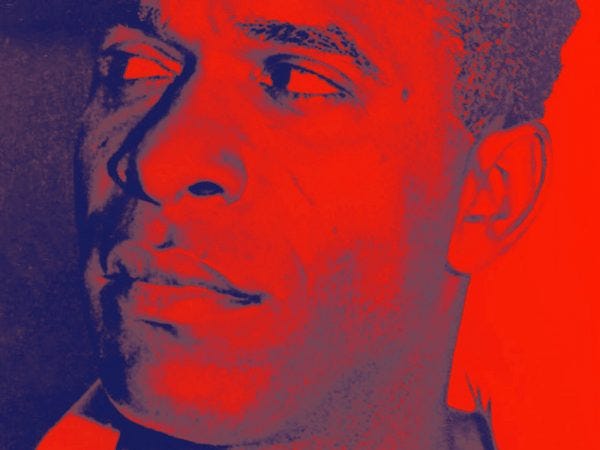
Frantz Fanon (1925–1961) was a French-trained psychiatrist, revolutionary intellectual, and one of the most important political theorists of the twentieth century. Without Fanon, postcolonial theory would not exist as it does today. His work reshaped how scholars think about colonial domination, racial identity, violence, and the conditions of empire.
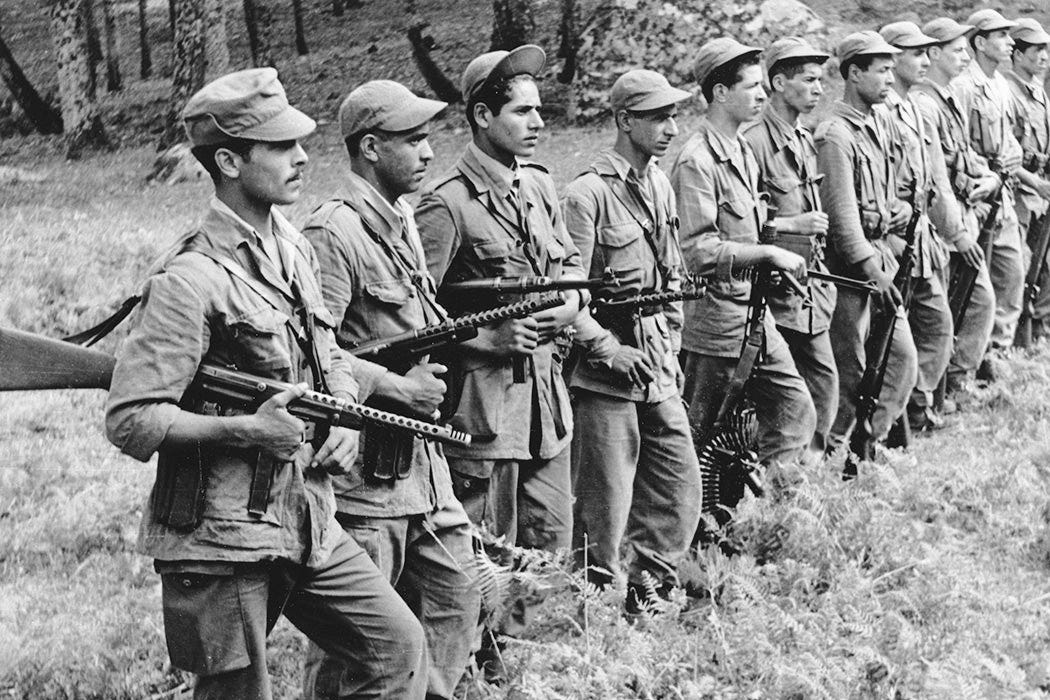
Fanon was deeply embedded in the struggle against colonialism — most notably as an active supporter of the Algerian Revolution and a member of the Algerian National Liberation Front. For Fanon, decolonization is a necessity because it is the only means of liberating the colonized from a condition of structural and psychic marginalization.
Trained in psychiatry, Fanon brought a unique view to political theory. Working in (colonial) mental health institutions, he questioned whether European standards of “normal” mental health could properly apply to colonized subjects. He argued that colonialism itself produces psychic injury—such as alienation and internalized racism— that cannot be treated without confronting the political conditions that produce these effects.
This blog post examines Fanon’s most acclaimed work, The Wretched of the Earth, published in 1961. While the entire book should be read, its reception has been shaped most by two sections: the Preface by Jean-Paul Sartre and Chapter One, titled On Violence, including its subsection On Violence in the International Context. All citations in this post refer to the Richard Philcox English translation (2004).
Preface
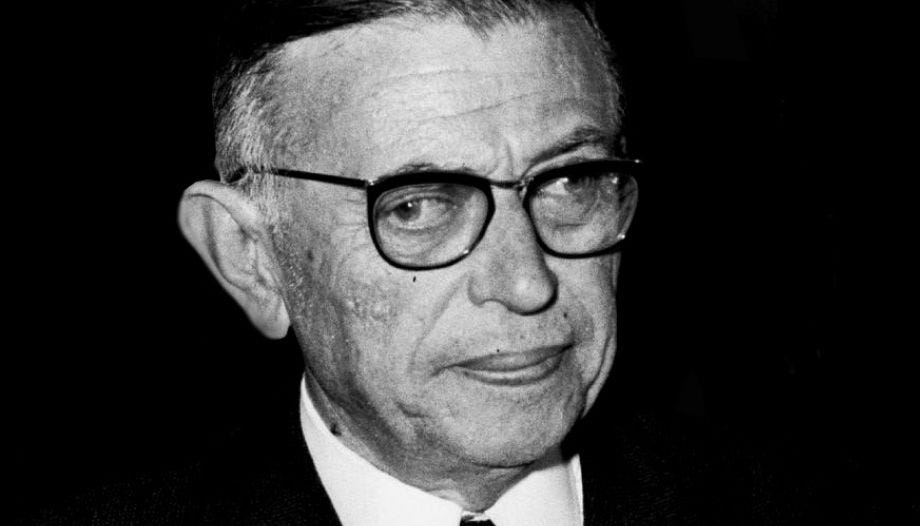
Jean-Paul Sartre’s preface to The Wretched of the Earth does not merely introduce Fanon’s text; it places Europe itself on trial. From the outset, Sartre makes clear that this book is not addressed to a colonized subject seeking recognition, nor is it a liberal humanist plea aimed at morally persuading the colonizer. Instead, Sartre directs the text toward the European elite — those who have long monopolized history and the right to speak. Sartre writes:
Not so long ago the Earth numbered 2 billion inhabitants, i.e., 500 million men and 1.5 billion “natives.”
The first possessed the Word, the others borrowed it.
The opening lines are striking in how quickly they establish an implicit dichotomy: one between “real” humans and “natives.” Within this Eurocentric logic, the native is denied possession of the “Word” — the capacity to speak truth purposefully and authoritatively. Only the Europeans were granted authority:
The European elite decided to fabricate a native elite; they selected adolescents, branded the principles of Western culture on their foreheads with a red-hot iron, and gagged their mouths with sounds, pompous awkward words that twisted their tongues.
Sartre describes assimilation as a violent process through which natives were forced to conform to the so-called “principles of Western culture.” These principles were not merely taught but engraved onto the bodies of adolescents — norms and rules imposed through discipline and punishment. Natives were required to dress in prescribed ways and to learn an awkward language that was not their own. They were beaten into acting and behaving like “real” men, yet even in this enforced imitation, they remained condemned.
Thus, Sartre positions Fanon not as a moral critic appealing to Europe’s conscience, but as a diagnostician speaking from the outside:
When Fanon, on the contrary, says that Europe is heading for ruin, far from uttering a cry of alarm, he is offering a diagnostic … As an outsider, he bases his diagnostic on the symptoms he has observed. As for treating it, no: he has other things to worry about. Whether it survives or perishes, that’s not his problem.
Fanon is not saying that Europe is collapsing in order to save it or to prevent its fall. He is describing Europe’s condition from the position of an outsider. Whether Europe collapses entirely or regains its strength is not his concern; his task is diagnosis, not preservation.
Sartre continues:
That’s the problem with servitude: when you domesticate a member of our species, you lower his productivity, and however little you give him, a barnyard being ends up costing more than he’s worth.
For this reason the colonists are forced to stop breaking him in halfway.
The result: neither man nor beast, but the “native.”
The colonizer requires the existence of the colonized. This relationship demands the production of a subject who is rendered lesser and subordinate. However, as Sartre observes, “when you domesticate a member of our species,” the process necessarily involves beating, flogging, and maiming. Violence is not incidental; it is constitutive. Yet this violence carries a contradiction: excessive brutality undermines productivity. To destroy the subject entirely is to destroy their usefulness.
The native thus occupies a singular and unstable position. Europeans killed many, but they also assimilated many — disciplined them just enough to extract labor, but not so much as to render them useless. Suspended between humanity and animality exists a unique being: the native.
Sartre writes:
They would do well to read Fanon; he shows perfectly clearly that this irrepressible violence is neither a storm in a teacup nor the reemergence of savage instincts nor even a consequence of resentment: it is man reconstructing himself.
Here, Sartre rejects the view that violence is an irrational outburst (akin to a baby throwing a tantrum). Instead, Fanon presents violence as productive: the process through which the colonized subject reconstructs themselves as human in a world that has reduced them to an object. Sartre states:
They are trapped between our guns, which are pointing at them, and those frightening instincts, those murderous impulses, that emerge from the bottom of their hearts and that they don’t always recognize.
For it is not first of all their violence, it is ours, on the rebound, that grows and tears them apart; and the first reaction by these oppressed people is to repress this shameful anger that is morally condemned by them and us, but that is the only refuge they have left for their humanity.
In this passage, Sartre shows that what appears to the colonizer as native “savagery” is in fact the condition of being trapped within a repressive colonial structure. The colonized are caught between two poles: the constant threat of European violence and the internalization of that same violence in the forms of shame, repression, and guilt. What Sartre calls the “murderous impulses” of the colonized may even appear unrecognizable to the colonized because these impulses are not necessarily known to them; they are responses to colonial violence itself. In this sense, violence emerges as the final resort through which the colonized subject can resist complete psychic subjugation. Sartre confirms this point:
Get this into your head: if violence were only a thing of the future, if exploitation and oppression never existed on earth, perhaps displays of nonviolence might relieve the conflict.
To relegate violence to the sidelines — to insist that it should remain only a future “last resort” — is to misread the contemporary moment. If exploitation and oppression did not structure the world, if there were no colonizers actively condemning the colonized, then nonviolent protest might suffice. But to claim that violence is unnecessary under existing conditions is to side with the oppressor and to moralize against those seeking lasting, material transformation.
Sartre closes the preface with a forceful claim:
This is the last stage of the dialectic: you condemn this war but you don’t yet dare declare your support for the Algerian fighters … The time is coming, I am convinced, when we shall join the ranks of those who are making [history].
We are at the end: it is easy to condemn war while withholding solidarity from those who fight — the working class, the colonized, the subjugated groups, and Algerian revolutionaries. But violence is not optional under colonial conditions. To eliminate the colonizer is to eliminate the very structure that produces the colonized subject.
On Violence
Fanon begins The Wretched of the Earth provocatively: he argues that decolonization is not reform or incremental progress, but a radical rupture within the existing legal order. Against liberal humanist accounts of peaceful, nonviolent transitions and the erroneous belief that the masses will have a moral awakening, Fanon insists that decolonization is a historical process marked by violence. He writes:
Decolonization, which sets out to change the order of the world, is clearly an agenda for total disorder…
Decolonization, we know, is an historical process: In other words, it can only be understood, it can only find its significance and become self coherent insofar as we can discern the history-making movement which gives it form and substance.
Fanon characterizes decolonization as “total disorder,” positioning violence as a form of political action. While critics often condemn violence as unjust or morally wrong — claiming that those who display acts of violence are “savage” and “irrational”— Fanon finds violence to be necessary. He recognizes decolonization as a “history-making movement” with its own logic and necessity. Given that colonization itself was a violent system built on torture, murder, and the forced assimilation of colonized peoples, Fanon argues that decolonization must reciprocate by eliminating the colonizer.
Fanon writes:
The colonial world is a compartmentalized world…
Yet if we penetrate inside this compartmentalization we shall at least bring to light some of its key aspects.
By penetrating its geographical configuration and classification we shall be able to delineate the backbone on which the decolonized society is reorganized.
In this passage, Fanon clarifies that colonialism extends beyond domination with periods of occasional violence. Instead, colonialism constitutes a comprehensive system of regulation, spatial organization, and social classification. The colonial apparatus operates through partitioning — dividing space, bodies, and existence into fixed, pre-established categories. Violence is not an aberration within this system; rather, it is the essential mechanism that creates and sustains these divisions. Therefore, dismantling colonialism’s structure inevitably requires violence, since violence itself is the foundation that upholds the colonial edifice.
Fanon continues:
The violence which governed the ordering of the colonial world … will be vindicated and appropriated when, taking history into their own hands, the colonized swarm into the forbidden cities.
To blow the colonial world to smithereens is henceforth a clear image within the grasp and imagination of every colonized subject.
Fanon emphasizes that decolonization does not introduce violence into a peaceful system; rather, it reclaims and redirects the violence that has been foundational to colonial rule. The same force structures colonial society — policing boundaries, enforcing racial segregation, controlling access to resources and basic needs — becomes appropriated by the colonized and repurposed in their liberation struggle. Fanon reframes this as acquiring ‘history-making power.’ Violence becomes an instrument of political reorganization. The image of exploding the colonial order to “smithereens” captures Fanon’s vision of what decolonization entails.
Fanon continues:
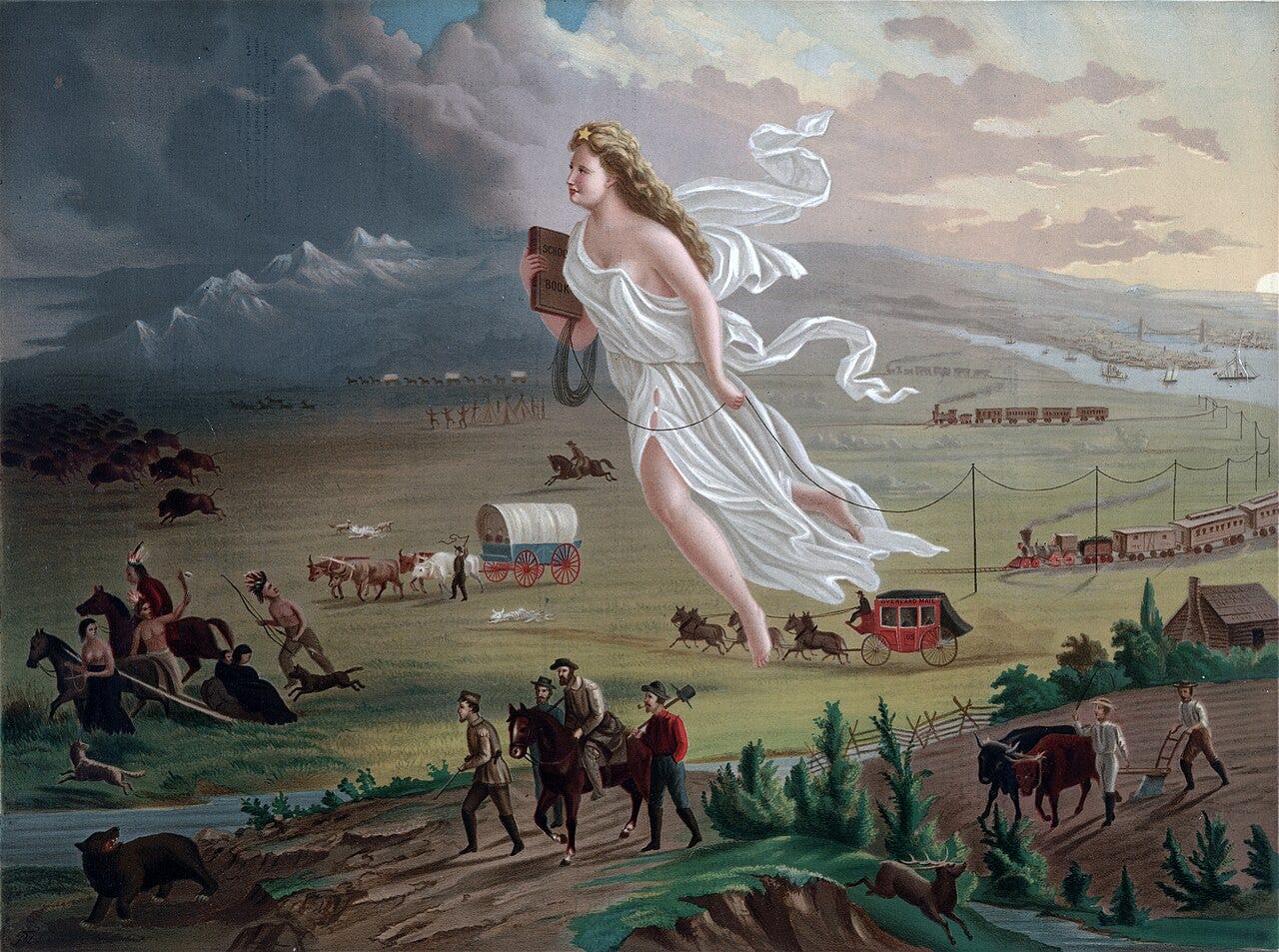
We have seen therefore that the Manichaeanism that first governed colonial society is maintained intact during the period of decolonization.
In fact the colonist never ceases to be the enemy, the antagonist, in plain words public enemy number 1…
The colonist makes history.
Decolonization does not suspend the Manichean structure of colonial society. By Manichaenism, Fanon refers to the world divided into two violent spheres — colonizer and colonized — structured by an absolute antagonism. The colonist remains “public enemy number 1” because the colonial order is organized through an irreducible opposition. The colonial world persists through the production of the enemy; and decolonization intensifies this opposition, galvanizing the colonized to fight back against the colonizers. When Fanon says that “the colonist makes history,” he is arguing that colonial domination controls the narrative of history. In this narrative, the colonized is positioned outside of history as an external enemy or threat.
At any rate, Fanon writes about the effectiveness of miltary violence:
… But guerrilla warfare, that instrument of violence of the colonized, would amount to nothing if it did not count as a new factor in the global competition between cartels and monopolies.
Without getting bogged down in the details of particular historical events Fanon references, his point is that violence becomes transformative insofar as it disrupts the global structures that sustain empire. One form of violence colonized peoples utilize is guerrilla warfare, defined by its capacity to fracture established relations of power. Fanon is careful to show that decolonial violence does not operate in isolation; it is embedded in a wider global struggle “between cartels and monopolies.” In this sense, revolutionary violence is also an intervention into the political and economic circuits through which imperial domination is reproduced globally.
Fanon writes:
For the colonized, this violence represents the absolute praxis…
The questions which the organization asks the militant bear the mark of this vision of things: “Where have you worked? With whom? What have you accomplished?”
The group requires each individual to have performed an irreversible act.
Violence is an absolute form of praxis. The militant assumes responsibility for action and must be able to answer for what that action has produced. It is within this framework that the colonized are said to perform an “irreversible act”: death admits no reversal.
Before turning to On Violence in the International Context (the second part of the first chapter), Fanon states:
At the individual level, violence is a cleansing force…
Violence hoists the people up to the level of the leader…
They prove themselves to be jealous of their achievements and take care not to place their future, their destiny, and the fate of their homeland into the hands of a living god.
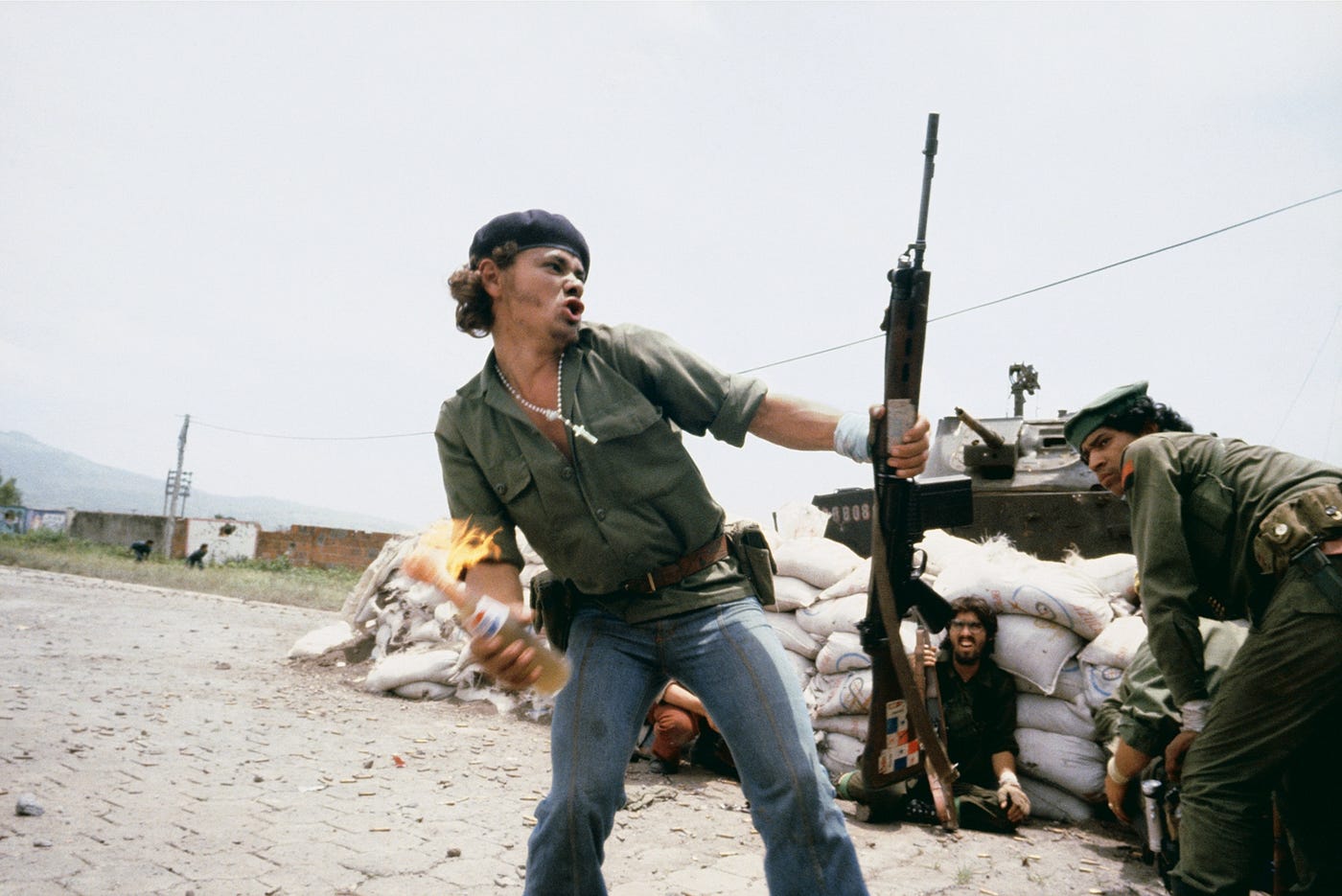
Fanon argues that violence is “cleansing” because it dismantles the internalized inferiority imposed by colonialism. This claim is not metaphorical: the colonized subject’s sense of self is constituted in relation to colonial power. To recover agency, that relation must be ruptured through violence. This violence is not undertaken to install a new overarching system of governance, but to reclaim one’s capacity to act as a political subject.
On Violence in the International Context
Up to this point, Fanon’s analysis has focused on the internal structure of colonial society. In the final section of the first chapter, titled On Violence in the International Context, he widens the frame, insisting that decolonization cannot be understood as a purely national process. Colonial domination is not confined to any single territory, and the end of formal rule in one region does not signal the end of colonial domination.
Fanon writes:
We must refuse outright the situation to which the West wants to condemn us.
Colonialism and imperialism have not settled their debt to us once they have withdrawn their flag and their police force from our territories.
Decolonization cannot be negotiated. Piecemeal reforms only perpetuate colonial domination; no legislation or political concession suffices. The debt is settled only when the colonial flag is lowered and military forces withdraw from the territory. Furthermore:
Europe is literally the creation of the Third World.
The riches which are choking it are those plundered from the underdeveloped peoples.
Fanon takes aim at the establishment of Europe. Europe’s wealth and quality of life depend entirely on the creation of the Global South. Underdeveloped nations supply the raw materials for European goods and receive only exploitation in return. In response to these criticisms, there have been many offering to lend the Global South a helping hand. But Fanon refuses this patronizing effort:
And when we hear the head of a European nation declare with hand on heart that he must come to the aid of the unfortunate peoples of the underdeveloped world, we do not tremble with gratitude.
On the contrary, we say among ourselves, “it is a just reparation we are getting.” So we will not accept aid for the underdeveloped countries as “charity.”
Such aid must be considered the final stage of a dual consciousness — the consciousness of the colonized that it is their due and the consciousness of the capitalist powers that effectively they must pay up.
Fanon refuses aid because the ruling class and Global North conceptualize it as charity. Liberal humanist efforts to help the Global South serve only to self-congratulate themselves and absolve their guilt. If aid is to be accepted, it must be understood as “the final stage of a dual consciousness” — meaning that wealthy nations recognize their property and wealth as inseparable from colonial exploitation and their willingness to effectively stop dominating the Global South.
However, Fanon is skeptical of any such proposals from Europeans:
But it is obvious we are not so naive as to think this will be achieved with the cooperation and goodwill of the European governments…
In order to do this, the European masses must first of all decide to wake up, put on their thinking caps and stop playing the irresponsible game of Sleeping Beauty.
Fanon ends the first chapter by explaining that colonized peoples cannot depend on the goodwill of Europeans for their liberation. Furthermore, this book is addressed directly to Europeans and to those who continue to benefit from colonial domination. If Europeans are serious about dismantling the colonial system from which they profit, they must finally wake up to their own implication in it. There can be no more pretending or ignoring the violence of the colonized.
Conclusion
Fanon’s The Wretched of the Earth has endured as one of the most essential texts in political theory. While violence is often condemned — even within a field that should be attentive to multiple forms of political transformation— Fanon refuses the fantasy of a peaceful transition from colonial domination. He understands violence as a necessary praxis of liberation: the means through which the colonized subject position can be abolished, a position that exists only so long as the colonizer does.
Leave a Reply